
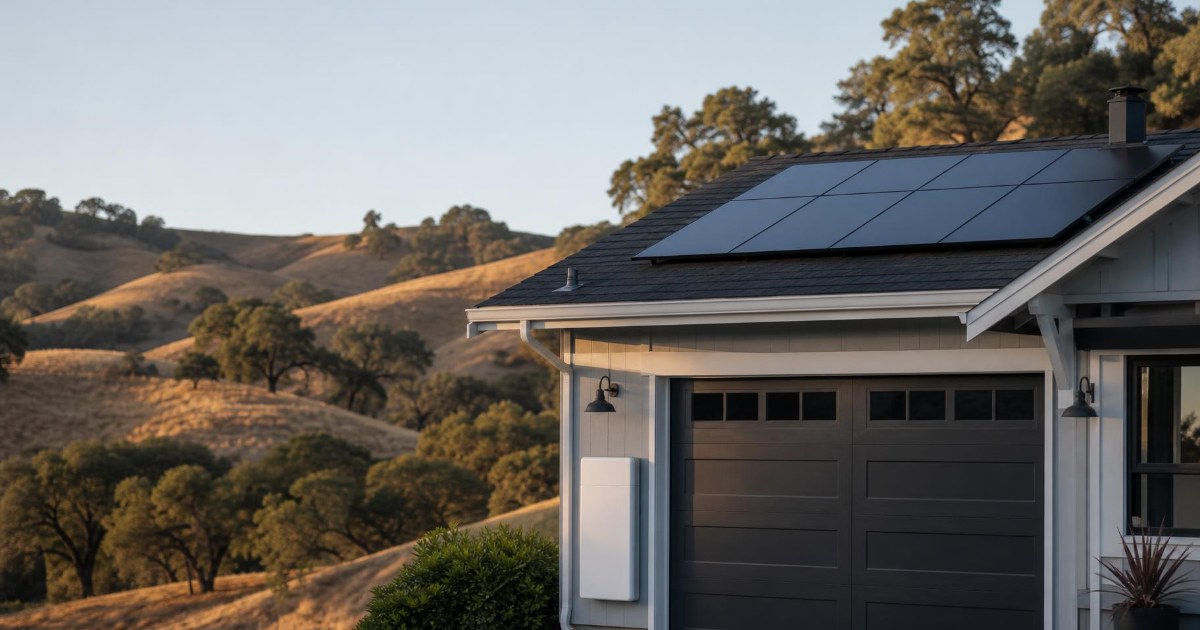
What can you still get in California in 2026 if you want solar or a battery? That question sits behind most searches for california solar incentives, and the answer changed at the end of last year. The 30% federal tax credit that homeowners relied on for years ended on December 31, 2025, and many guides online still describe it as if it were on the table. This page covers what is real today. You will find the state battery rebate program and where it stands, a property tax benefit with its own deadline, a program for income-qualified households, and the reason NEM 3.0 puts a battery at the center of a smart system. Sun First Solar has been designing systems for Northern California homes since 1984, so every number here is chosen with a homeowner's bottom line in mind. Call 415-458-5870 and we will check which of these incentives apply to your home on the same call.
What Changed: The Federal Solar Tax Credit Ended in 2025
For years, the Residential Clean Energy Credit, often called Section 25D, let homeowners subtract 30% of their solar and battery costs from their federal income taxes. That credit no longer applies to property placed in service after December 31, 2025. Congress ended it in the 2025 reconciliation act, which repealed the credit for expenditures made after calendar year 2025. No reinstatement is scheduled.
The timing rule matters most to anyone who began a project late last year. A system installed and paid for in 2026 does not qualify. That includes a system that was partly finished in 2025, because the expenditure counts in the year the work is completed. A homeowner who finished a system in 2025 and claimed the credit on that return can carry any unused amount forward to later tax years under the usual carryforward rules.
People who search for a california solar tax credit often land on articles written before the repeal, and those articles quote a 30% discount that no longer exists for new purchases. The incentives that remain come as rebates, a property tax rule and rate-based savings. They are smaller in some cases and larger in others, and they depend on the household. The sections below walk through each one.
California Incentives Still Active in 2026
Even without the federal credit, California still has incentives for solar and battery storage, though some have closed or have waitlists. Solar rebates in California come from a few places: a statewide battery program, a property tax rule, a program for income-qualified homeowners and, in some areas, a local utility. Each has its own eligibility rules. The sections below start with the largest dollar amounts and finish with the smallest.
SGIP battery rebates
The Self-Generation Incentive Program, known as SGIP, pays homeowners for installing battery storage. It is the highest-dollar program on this list, and what a household receives depends on its tier. At the most recent program update, the general-market residential tier's current step rate is $0.15 per watt-hour, or $150 per kWh. An sgip rebate at that level is a helpful credit toward a battery, and a modest one.
The Residential Solar and Storage Equity and Equity Resiliency tiers pay far more. The Residential Solar and Storage Equity tier pays up to $1,100 per kWh of storage and the Equity Resiliency tier pays up to $1,000 per kWh. Equity Resiliency serves households in high fire-threat areas and areas affected by public safety power shutoffs. The Residential Solar and Storage Equity tier serves income-qualified households.
Here is the math on a Tesla Powerwall 3, which has 13.5 kWh of base capacity. At $1,000 per kWh, the sgip battery rebate comes to roughly $13,500 before any other savings. At the general-market rate of $150 per kWh, the same battery earns about $2,025. Both figures show why the tier matters so much.
SGIP budgets and step levels change. On the program's November 2026 tracker, the general-market, Residential Solar and Storage Equity (Ratepayer) and Equity Resiliency steps are closed in PG&E territory, and the AB 209 equity categories have waitlists. A current eligibility check shows what is open for your address and your household. Sun First Solar is a certified Tesla Powerwall installer, and our team handles Bay Area projects from design and installation through permits, approvals, rebates and financing. You can request a free quote that includes a current SGIP eligibility check and see which tier fits your home.
The property tax exclusion and its own deadline
California does not raise a home's property tax assessment for the value a solar system adds. The rule covers solar and solar-plus-battery systems, so a home that gains value from panels is not reassessed at a higher amount because of them. The exclusion is scheduled to end for new installations after January 1, 2027. Systems completed and in service before that date keep the exclusion for as long as they remain eligible.
That date is a second countdown, separate from the federal credit. Design, permitting, equipment delivery and utility interconnection each take time, and a system has to be in service before the deadline to count. Homeowners who plan to go solar within the next year have a clear reason to start the conversation now. Our own crew works out of San Rafael and handles each step from permitting through interconnection, which keeps a schedule like this in one team's hands.
DAC-SASH for income-qualified homeowners
The Disadvantaged Communities Single-family Affordable Solar Homes program, called DAC-SASH, offers no-cost solar for income-qualified homeowners in disadvantaged communities. GRID Alternatives runs it for customers of PG&E, SCE and SDG&E. The program pays a flat $3 per watt for systems of 1 kW or larger, which works out to $15,000 for a 5 kW system.
Eligibility is narrow. A household needs to meet income limits and live in a qualifying community, so this program fits a small share of homeowners. Sun First Solar has supported GRID Alternatives and other local not-for-profit programs for years, and we are glad to point a qualifying household in the right direction.
Local utility rebates
Some local utilities add their own rebates for solar or storage. The amounts are usually small and they vary by provider, so a homeowner's own utility is the place to check for the current list. We include these in the incentive review for each property, which keeps any small rebate from being left behind.
How a Battery Changes the Math Under NEM 3.0
NEM 3.0, formally the Net Billing Tariff, pays much less for power sent back to the grid than the earlier NEM 2.0 rules did. For pg&e nem 3.0 customers, export credits follow wholesale electricity costs, which in California average about 25% of retail rates, and the 2026 export adder for customers outside the low-income and DAC groups is about 0.9 cents per kWh. A kilowatt-hour sent to the grid earns a fraction of its retail value. The same kilowatt-hour used in the evening replaces power that costs several times more.
That gap is why a nem 3.0 battery has moved from a backup-power extra to the financially sound way to build a system. A battery stores the solar power your panels make at midday and releases it when your home needs it most. Time-based control lets a battery charge during low-rate periods and discharge when rates are higher. Self-consumption goes up, and the evening grid bill goes down.
This is also why the SGIP battery rebate has become so central to the incentive conversation. For households in the Residential Solar and Storage Equity and Equity Resiliency tiers, the battery rebate can be the largest incentive number in the whole project.
At Sun First Solar, we offer a customized solar-plus-battery design because the current rate structure rewards it. Our battery storage options include the Tesla Powerwall 3, which scales from 13.5 to 67.5 kWh with whole-home backup, and the Enphase IQ Battery, a modular system that comes in two capacities. Our own crew installs every battery system, so one local team stays with you from design through interconnection.
Financing That Still Captures a Credit
Homeowners who lease a system or sign a power purchase agreement do not claim a tax credit themselves. The company that owns the equipment can still claim a separate federal business energy credit, and some of that value can show up as a lower lease or PPA payment. The share that passes through depends on the contract, so two homeowners can see different savings from the same type of agreement.
That is worth knowing because it means the federal picture is not zero everywhere. It also means the monthly payment on a lease or PPA deserves a close read, since the incentive value sits inside the contract terms. Sun First Solar offers financing for homeowners who prefer to buy a system outright or pay it off with a loan, and our team walks through how each path interacts with the incentives above.
What This Means for Your Bottom Line
The flat 30% discount is gone. The programs that remain can still change the after-incentive cost of a system in a meaningful way, and SGIP for battery storage is the largest when a step is open. Its fire-threat and PSPS tier is closed in PG&E territory on the November 2026 tracker, and the property tax exclusion rewards a system that is in service before January 1, 2027.
Which of these programs apply to your property depends on your address, your utility, your household and the design of the system. A site review answers all four at once. Our residential solar team designs the panels and the battery together, and we will tell you what is open today. Call 415-458-5870 or send us a free quote request and we will build the quote around the incentives your home can actually claim.